Stories Are Dangerous
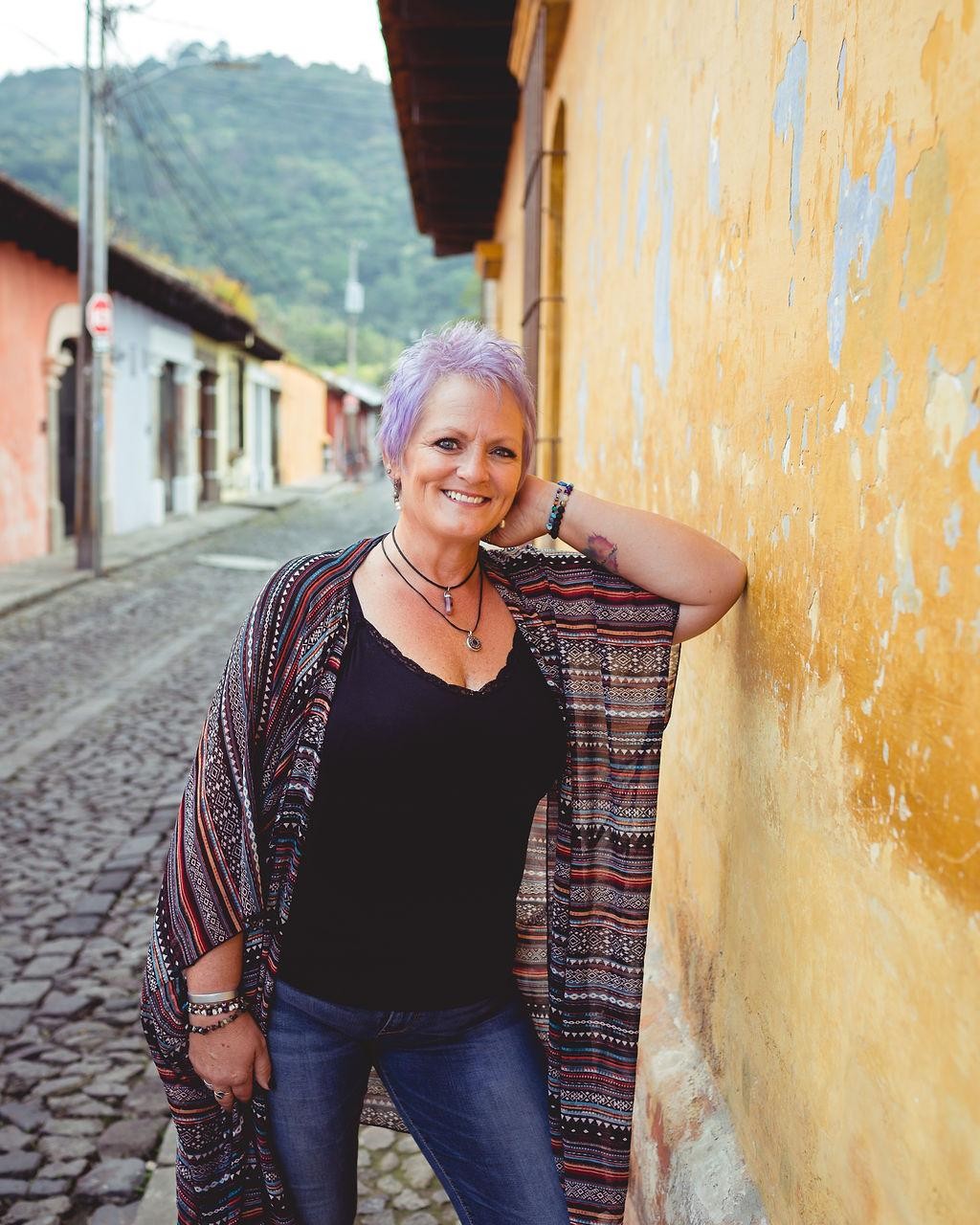
Ronda Taylor has spent forty years in book publishing, and the last ten years have been living and working around the world. She sold nearly everything she owned, bought a backpack and a one-way ticket to Costa Rica, and took her business with her. At 63, she is still building, still evolving, and still deciding which stories to believe.
I.
Her management position was eliminated twice, both times during corporate buyouts.
The second time, she made a decision she has kept ever since.
“That’s when I decided that no one was going to choose my fate anymore.”
She became an entrepreneur in October 2003.
She has worked in book publishing for forty years, including running a publishing company and spending roughly twenty-five years designing books. Complex interiors became one of her specialties, but her work has continued to evolve alongside the industry and the authors and entrepreneurs she serves.
“I’ve been doing this a long time, so there’s a lot to tell,” she says by way of introduction, and then lays out forty years in a few sentences, apologizing in advance for talking too long.
“I have a habit of just not shutting up. I’ll just go and go and go.”
She does go.
It is worth following her.
II.
The idea arrived as a work order.
In 2008 she was hired to design a book for a woman named Jane Stanfield, who had taken a year off to travel the world and volunteer. The book was called Mapping Your Volunteer Vacation. Designing it meant living inside everything Jane had experienced.
“That planted the seed. I had no idea traveling the world and volunteering along the way was even a concept.”
“I knew that was something I wanted to do.”
She had wanted to travel her whole life. As a girl, she wanted to be a flight attendant. Instead, she became a young mom, and life went the way it went.
The seed sat for eight years.
It ended up on a vision board in Las Vegas, where she lived with her youngest, still in high school. Her plan was specific: spend a few months in Central and South America, volunteering with women entrepreneurs and collecting their stories for a book about female entrepreneurship across the Americas.
Around the same time, her marriage ended amicably.
“We loved each other, but we weren’t in alignment with our futures.”
The end of the marriage didn’t create the dream of travel. That dream had been there for years. But for the first time, she was free to find out where it might lead.
She took what she calls a bold leap.
“I ended up selling nearly everything I owned, and I bought a backpack and a one-way ticket.”
She left the United States for Costa Rica in November 2016. She landed in Liberia, and twenty-four hours later she was on a bus to Nicaragua, where her first volunteer post was waiting: a woman running a yoga ashram in the jungle.
She spent her first thirty days abroad there.
III.
She never stopped working.
“I couldn’t take a year off and not work, right? So I packed up my book design business and took it with me.”
Over the next year she interviewed twelve women entrepreneurs across Nicaragua, Costa Rica, Guatemala, Panama, Colombia, Peru, Chile and Argentina.
Some ran little stores on street corners and had no internet at all. One owned a restaurant in Panama. One ran a motorcycle shop on a Nicaraguan island with her husband. One ran a secluded retreat center in Costa Rica.
The trip was planned for three months.
“When six months came and went, there was no way I could leave that life. It changed me. It changed everything about me.”
“It changed me. It changed everything about me.”
She ran her business across continents, through bad Wi-Fi and hard deadlines. Over the years, she would travel and work across dozens of countries.
She had no playbook.
“I didn’t read a book. I wasn’t coached by anyone. I literally just jumped in with both feet. I didn’t even speak another language.”
Anyone with her in those first twenty-four hours, she says, might have gone straight back to the States. She was attacked for her cell phone.
She learned to adapt, and that shaped how she traveled, worked, and ran her business.
What she learned about the women she met was simple and hard.
“The women really had to jump through a lot more hoops to establish themselves as entrepreneurs. They simply weren’t viewed the same way.”
IV.
Before the backpack there was a stage.
In 2015 she applied to give a TEDx talk. She was a publisher by then, in the business of bringing other people’s stories into the world, and she had one of her own she had never told.
“There’s a part of my life that I’ve never said out loud.”
The talk is called Stories Are Dangerous.
Hers was this:
“I was physically abused as a child by my father. And that led to violent relationships in my young adult life.”
In her mid-twenties, she survived a night of violence that nearly cost her life. She was a young mother of two, living in Colorado, and had been held against her will in her own apartment. The following morning, a brief opportunity to escape presented itself.
“I knew at that moment that if I didn’t take the opportunity to run, I wasn’t going to survive. And I bolted.”
She got out.
For decades, she kept much of that history to herself. When she finally shared it publicly in her 2015 TEDx talk, her father had already passed away. Before the video went online, she called her family one by one to tell them what she had revealed on stage.
“My family was devastated.”
The apologies that came were more than she was asking for. She wanted them to hear it from her before the internet did.
The premise of the talk, in her words, was how she went “from a victim mentality” to “ultimately reclaim responsibility and take ownership of the life that I lived.”
It was the first time she had ever spoken on a stage.
“Speaking my truth on stage set me free.”
“Speaking my truth on stage set me free.”
But she was her own worst critic. She wasn’t a polished professional speaker, and she noticed every little mistake, even the ones no one else seemed to see. For years, she refused to share the video.
“I was like, yeah, I’m a TEDx speaker. You want to see it? Sorry, I’m not sharing it.”
That has changed.
The question at the center of the talk still stands.
“If we don’t share our stories, how will we ever know how many lives we could change by speaking them out loud?”
V.
Three years ago the floor moved under her trade.
“The publishing industry was changing with the onset of AI. I stepped back for a minute and thought, ‘My career is over.’ I felt threatened.”
As AI began reshaping publishing and creative work, the profession she had known for decades suddenly looked different. For the first time, she wondered whether the expertise she had spent a lifetime building still had a place.
She also began putting more energy into Midlife Rondavous, the platform born from her own years of nomadic travel, where she helps women in midlife explore solo travel, location freedom, and working from anywhere. She built NomadFlow, an app designed to help make that kind of life easier to navigate.
Then she got curious.
“I got curious. I leaned in and spent the next two years learning how to amplify what I already knew.”
What she found on the other side was not that AI could not do creative work. It was that forty years of experience had never been just production.
She still crafts her interiors page by page, informed by decades of publishing experience and the judgment that comes with it. She has learned to use AI elsewhere in her work, not as a substitute for what she knows, but as a tool to amplify it.
Around that expertise, she has continued to evolve HeartWork Creative, expanding beyond book design and publishing support to help nonfiction authors and experts connect their books to the readers, visibility, and business opportunities they were meant to create.
Then came another blow.
A client of fifteen years, who had provided much of the financial stability that let her business travel with her, decided to take a sabbatical and shut everything down.
“I lost my income overnight.”
Since then, she has spent her time rebuilding.
Somewhere in that rebuilding, she caught herself doing the very thing her talk had been about.
“I was still telling dangerous stories to myself about what I could no longer accomplish. I’m too old. It’s too late. Maybe I made a mistake.”
A decade after standing on a stage to say that stories are dangerous, she found herself facing a new set.
“Is this too late for me?”
VI.
Her answer is the way she lives.
“I’m 63 now, and life is too damn short for the what-ifs. For the last ten years, I’ve been living unapologetically.”
“Life is too damn short for the what-ifs.”
She has built an intentionally mobile life. This summer, she lived in a park model at an RV park in the Arizona mountains, hiking, paddleboarding, and working. When we spoke again in September, she was in Colorado Springs, where she raised her kids, and on her way to Maine in October to spend a month with her two youngest granddaughters.
Not everyone understands the life she chose.
“I’ve been labeled irresponsible or reckless, like this must be some kind of midlife crisis.”
She has three children and six grandchildren, and that freedom allows her to be present for the moments that matter most. She was there for the births of both of her youngest daughter’s girls, staying through each maternity leave. And when an unexpected family tragedy struck, she was able to catch the first flight out to be with the people who needed her.
“I live a very unconventional life in my 60s, and I’m proud of the life I’ve created.”
She warned us the next part would make her emotional.
“I still wake up every single day believing in what’s possible and fighting for what’s next. I’m not a quitter.”
VII.
Ask her what entrepreneurship gave her, and she starts with the good news.
“Entrepreneurship has given me extraordinary freedom.”
Then the warning, from a decade of working wherever she landed.
“I learned the hard way that entrepreneurship without boundaries can consume the freedom it was supposed to create.”
At 63, she is still building.
“The most beautiful thing is that I know more now. And I know me better now.”
She is starting over, she says, but she is not starting from scratch. She is starting from experience.
And she is careful about what she wants a younger woman to take from her.
“I wouldn’t want young women to leave my story thinking entrepreneurship is easy by any means. I want them to leave knowing they have far more choices than they probably realize.”
If the whole conversation comes down to one word, she knows which one.
“Permission.”
“It’s what every woman deserves, and it’s what many women don’t think they’re allowed to give themselves because of the roles they play. Society says that when you reach a certain age, you should stop behaving this way, stop doing certain things, and start living the way you’re expected to live. And I’m like, forget that.”
Freedom looks like
“I want women to know it’s okay to put themselves first sometimes and say yes to what their hearts are calling them to do.”
“For me, it’s always been about legacy. I want my children and grandchildren to know they’re never too old to start over, follow their hearts, and pursue their dreams. It’s never too late.”
It’s never too late. Ronda Taylor · HeartWork Creative and Midlife RondavousSources: World Bank, Women, Business and the Law 2024, March 2024 · Azoulay, Jones, Kim & Miranda, “Age and High-Growth Entrepreneurship,” American Economic Review: Insights 2(1), 2020.