Twenty Founders, One Cleaning Company and a Friday Back
Twenty women founders spent a day running a business that wasn’t theirs. By lunch the owner had 12 hours of her week back, and the fixes that did it were the ones most small businesses never get around to.

On Thursday, November 12, the second floor at Elevator in downtown Des Moines filled with women who run their own companies: realtors, consultants, designers and first-year founders. Nobody worked on her own business in the morning. Every table worked on Harlow’s.
Harlow Reyes runs Harlow Home Care, a residential and Airbnb cleaning company in the Des Moines metro. She is a solo founder and a single mom of two in Ankeny. She works alongside three contract cleaners, still cleans two days a week herself, and puts in 52 hours a week. Her goal for 2027 is simple: keep her Fridays and still make a profit.
Harlow is a sample company, built for the day from the problems real owners describe. Her invoices, budget, staff list, website, reviews, contracts and client list were all in the room, and so were ten problems hidden inside them.
How the day worked
The room played Harlow’s year one month at a time, and every month brought a new problem. Five tables each owned a part of her business: one on money, one on finding clients, and three on operations.

- A card turned over. Each month opened with what went wrong for Harlow: a blizzard, a late payer, a tax bill.
- Tables built a fix. Each table wrote a plan for the month and built it: the text, the contract, the booking page, the price notice. Every finished build came with a ready-to-use Claude skill so anyone could run it again.
- The fix had to win Harlow over. Tables pitched each build to Harlow herself. When she said yes, a coach rang a bell and the table earned points for proof.
- Tables dug through her files. Points also came from finding the problems buried in her records.
- The scoreboard moved her numbers. Each fix changed Harlow’s hours, profit, clients, support and rating on a live dashboard on the big screen.
Coaches circulated all day, and judges from NAWBO Iowa, the University of Northern Iowa, FemCity Des Moines and Drake heard the pitches in the afternoon.
What the tables built
In six months of Harlow’s year, the tables made 36 working builds, each with a written plan. The pattern was clear by March: almost none of them needed new software.
| Harlow’s month | What went wrong | What the tables built |
|---|---|---|
| January | A blizzard cancels 40 cleans | Weather-day texts with three makeup slots, a self-reschedule calendar, a $25 loyalty credit, a backup cleaner network |
| February | 40% of leads arrive after 6pm | A booking link on her website and Google profile, after-hours auto-replies, a lead-sharing deal with a partner company |
| March | A cleaner raise eats her margin | A 9% price notice with a confirmation tracker, and a Priority membership at $49 and $100 a month |
| April | A property manager pays late, and the tax bill lands | Net-30 terms with late fees, prepay terms, a higher Airbnb turnover price, a collections script with automatic tax savings |
| May | A builder offers 30 homes, with no loan behind it | The contract with a 50% deposit, a counteroffer for 20 homes, a finder’s fee deal with partner crews |
| June | She hits 58 hours a week | Card on file with automatic payment, a shared capacity tracker, and her lead cleaner answering texts after 6pm for $200 a month |
The hidden problems turned up just as fast. Four tables found the unanswered Google reviews. Four found the dead inbox. Five flagged the late-paying client, and four caught the 90-day payment terms buried in the builder contract. Four spotted a cleaner paid as a contractor who belonged on payroll. By the end of the morning, all ten problems in her files had been found.
The scoreboard
By the end of June in Harlow’s year, the room had given her 12 hours of her week back. Her monthly profit rose from $2,500 to $2,800, her support went from one person she could call to four, and her rating climbed from 4.6 to 4.8 stars.
The hard part came early. The blizzard pushed her to 55 hours in January, and the fixes took months to add up. June was the turn, when card-on-file payments, after-hours booking and a lead cleaner who answers evening texts landed together.
The top table on points was the Money table: Teske, Ella, Penny and Jennifer, with 334 points. They were the only table to solve all six months and they found all ten hidden problems. Their work was the least glamorous in the room: payment terms, a deposit, a price rise, a card on file. Each one gave Harlow time or cash. Their prize is a month of coworking at Elevator.
| Table | Focus | Points |
|---|---|---|
| Money | Her margins vanish before she notices | 334 |
| Operations 1 | She hired AI to save time, and now it eats her time | 271 |
| Finding clients | Her customers stopped searching and started asking AI | 219 |
| Operations 3 | Her team only talks through her | 193 |
| Operations 2 | She hired AI to save time, and now it eats her time | 172 |
The five pitches
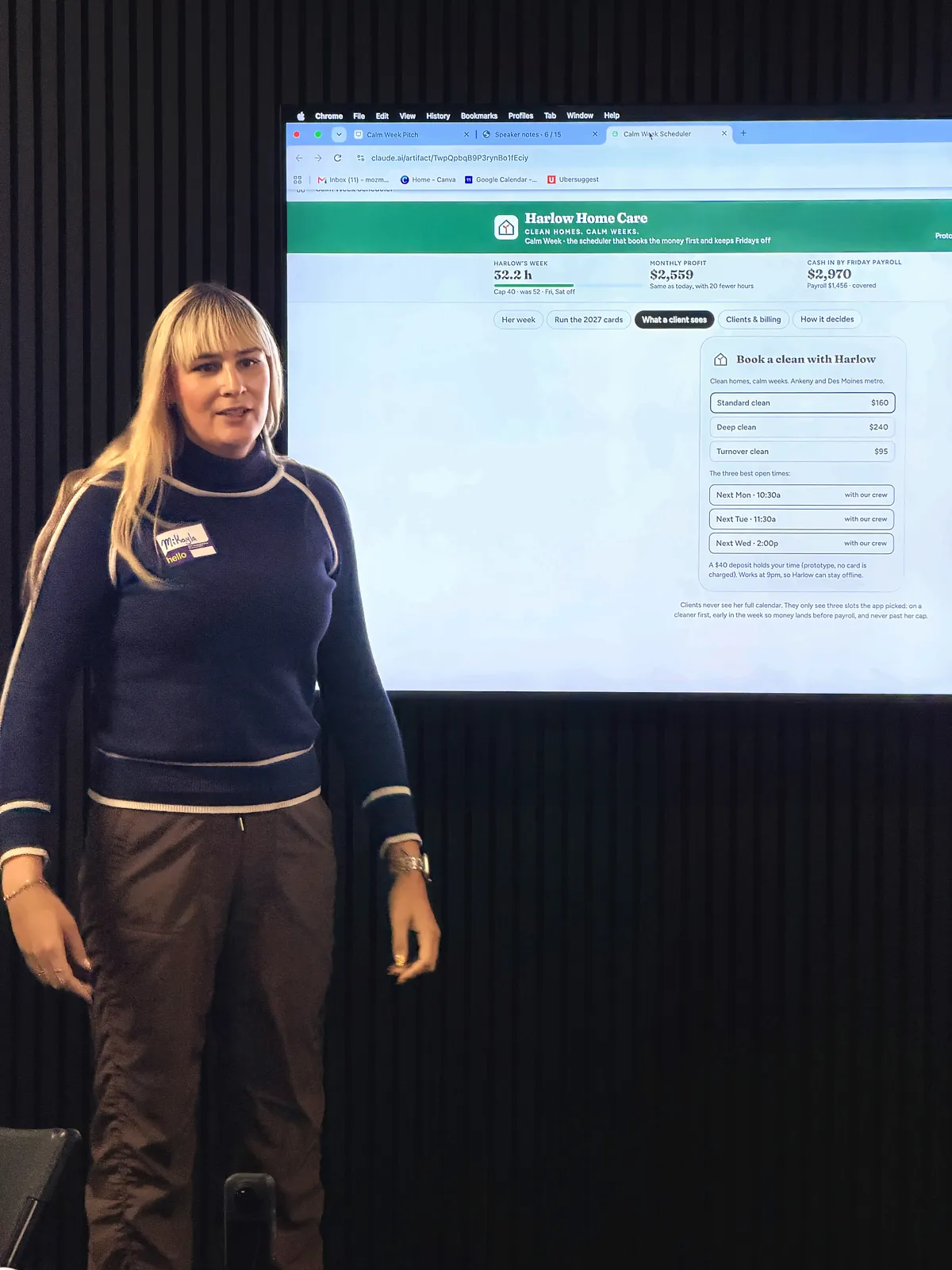
In the afternoon each table stood up and pitched Harlow on one big move for her year. Two showed working builds, one showed the setup inside the software she already pays for, and two brought plans with numbers.
- Harlow’s Home Club. A membership at about $100 a month with priority booking, saved preferences and 15 minutes of extra tidying each month, plus an AI assistant that answers late-night texts and reminds clients who owe her. If 40% of her clients join, that is about $3,400 a month she can count on.
- Run it all in Jobber. Drop the tools that overlap, raise prices by a reasonable amount for clients and crew, cross-train one cleaner on admin for emergencies, and win back the 21 clients she lost touch with.
- Turn on what she already pays for. Four of the six features Harlow needed were already in her Jobber account, switched off: online booking, a client portal for rescheduling and paying, a crew app with shifts and routes, and repeat scheduling. The only new cost was $108 a month for an after-hours AI receptionist and review tools. The table acted it out as a skit, with team members playing Harlow, a client and a cleaner.
- First Friday back in three weeks. A working booking app that puts jobs straight on her calendar, reassigns them when a cleaner calls in sick and answers new leads. Clients prepay a year at a discount, and realtors buy cleaning as a closing gift for their buyers.
- An AI business audit. A working tool where an owner talks for 45 minutes and gets back a report across seven areas, from unpaid invoices to quality of life, with what to hand to a person, what to hand to AI and a 30-60-90 day plan. The table ran it on Harlow live.
Four of the five pitches arrived at the same three moves: answer the after-hours lead, bring in money upfront, and use the tools she already has before buying anything new.
What it means for your business
Most small business owners are a few boring fixes away from getting their week back. The room proved it on Harlow, and then each woman took the builds home: every one of them comes back to the founders who made it as a resource they can make their own, with the table that built it credited.
Three questions any owner can ask this week:
- Who answers when a client reaches out after 6pm?
- What am I paying for that is switched off?
- Where could a deposit, a card on file or a prepaid plan replace chasing money?
The founders were just as direct about the day itself. They asked for more time building and less time talking, a beginner track and an advanced track, a track for the builders who want to code, and tables of four or five. They also asked to meet every quarter. So the Women’s Business Hackathon is coming back four times in Des Moines in 2027, starting March 4, with rooms planned in Omaha, Minneapolis, Kansas City and Chicago.
Thank you to Elevator, NAWBO Iowa, FemCity Des Moines and 1 Million Cups, and to every judge and coach who gave the day their time.