We Were Obviously Projecting Small Energy
Natalie Brown was a healthcare worker caring for her nan and watching her mother go through cancer when the burnout arrived. Four years later she runs an accountancy firm with her husband, works three days a week, and got the clients she actually wanted by getting off Instagram and into rooms.
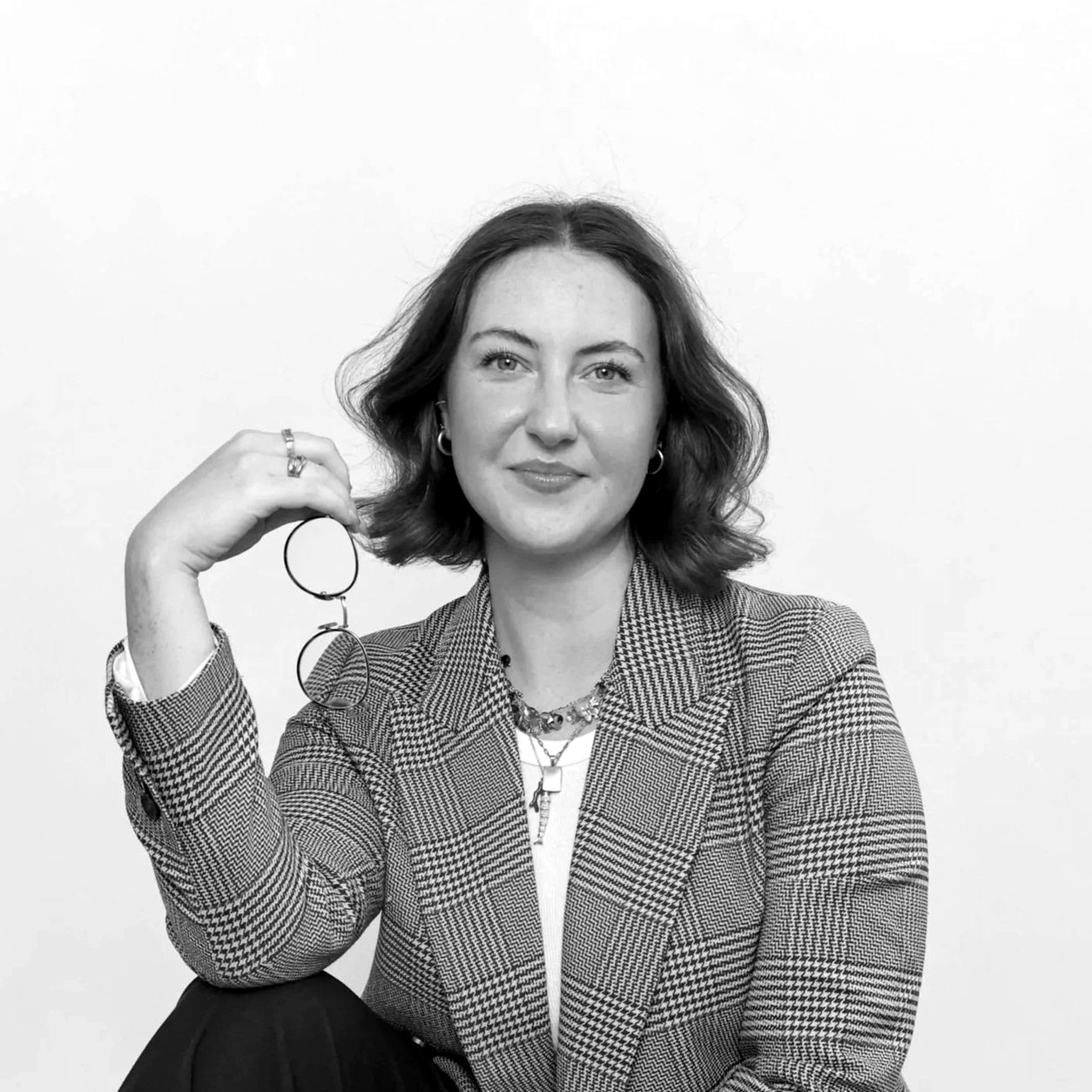
I.
Ask Natalie Brown what her job title is and she does not have one.
“I need to give myself a job title, which I don’t really have. But I think that’s ultimately what having your own business feels like, doesn’t it? You just do all the things.”
What she actually does has a name, though nobody prints it on a card. On client calls, when her husband gets too far into the numbers, she translates.
“A little bit of translation on calls with clients when Sam gets too stuck in the numbers, and what they were really asking is, can I afford to go on holiday.”
That is the whole business in one sentence, and it took them a while to work out that it was hers.
II.
myQuarterly is going into its fourth year. Two founders, married to each other. Sam is the accountant.
Natalie came from healthcare. She worked through COVID, and the short version of that period runs long: her mother got cancer, she became sole carer for her nan, and the job paused for neither.
“It was just all incredibly stressful.”
Meanwhile Sam was inside an accountancy firm watching the model fail the people it was meant to serve. Everything once a year, after the fact, too late to change anything.
So they decided to do it themselves. And Natalie, reasonably, went and got a bookkeeping qualification. He was the accountant, so surely that was where she would be useful.
“And boy, were we wrong.”
They now outsource the bookkeeping. What Natalie brought out of healthcare turned out to be the skill the business was missing.
“Working in healthcare, your communication is a massive skill. And we realised that that’s what my skill was in the business.”
It took a little while to pivot. It is the single most consequential thing they did.
III.
The catalyst comes in two parts, and the order matters.
“Ultimately, burnout, quite severe burnout and depression, came from looking after people and still being employed.”
That was the straw. The bale underneath it had been there much longer, and she names it more precisely than most people manage.
“I was a conscientious worker and I didn’t get the rewards of being a conscientious worker. Does that make sense? Whereas you work for yourself, you work hard, you get the rewards.”
Her mother is now cancer free. Her nan and granddad have both since died. So the caring years are behind her, which lets her say the thing that would be unbearable to say in the middle of them.
“If I was, like, five years ago, caring for nan and mum, I wish I was working for myself. Because it would have given me so much more. Not just time, but mental and emotional capacity to care for the people you love.”
IV.
Here is what she built with the freedom, and it is deliberate to the point of being an argument.
They have no employees. They decided at the start that they never wanted to be employers, and they have held to it.
“We didn’t ever want to be employers. So we have found ways of growing without employing staff directly, because that was important to us.”
What they have instead is a payroll firm with a named person assigned to their clients, working from their email addresses. “She looks like she comes from us.”
“You could say we have, like, two team members. But they’re not technically, on paper, our teammates.”
She works three days a week. Sam works four.
The mental side never clocks off, and she is unbothered by that in a way that would alarm a wellness consultant.
“Mentally, you never switch off, do you. I’m sure to other people that would feel like the worst thing they could ever think of in their life. But it really doesn’t bother me. I like what we do, and it’s quite exciting when you’re coming up with new ideas.”
“Work backwards from the life you want.”
V.
The day is built around the fact that her brain does not work in the morning, and she has stopped pretending otherwise.
Half seven, she wakes. She stays in bed with a book and a cup of tea. Eight o’clock, breakfast. Then a morning class, and this is where the whole architecture shows itself.
“Quite inconsiderately, their classes are at, like, nine, ten or eleven. Which, if I was going to work, I just could not do. But because I don’t, I can.”
She comes into the office before lunch and does the easy things: email, LinkedIn, and a pass through every client’s social media.
“It’s important that we know what is going on in their lives and businesses. And sometimes Instagram is more forthcoming than they remember to tell us.”
Afternoons are deep work, because that is when her brain arrives: setting up automation, building slides for a speaking engagement, designing a new service.
Then home, where Sam cooks. Then the walk, which works as a switch.
“I don’t know if either of you have dogs. We don’t have dogs, but they get the zoomies in the evening, and my brain will get the zoomies in the evening if I haven’t been taken on my evening walk.”
VI.
The hobbies were her idea, and they exist for a structural reason.
Early on the two of them noticed that they had stopped having separate days to report on. There was no office gossip to bring home, because home was the office and the colleague was the husband.
“We were just talking about the business twenty-four seven, even in our downtime. And that just wasn’t healthy.”
So he rock climbs and plays board games. She swims and does pilates.
“Which feels really sad to say that’s my hobby. But I really like moving my body.”
They also hired a cleaner, early, on purpose. Both are the same decision in different clothes: buy back the hours, and buy back the conversation.
VII.
The gremlin has a script, and she can quote it.
“Everyone likes to say they’re a perfectionist, but I really do think I’m a perfectionist. So ultimately it’s: you’re not doing good enough.”
The specific shape it takes is worth reporting exactly, because it is the occupational hazard of a business built on communication. A client sends a WhatsApp message. She cannot read the tone. She spirals.
“I will spiral, and then I’ll have to catch myself. Be like, no, this person is happy. This person is happy with us. We are doing a good job for them. And then ultimately tomorrow you get another message where they say, ‘Oh, thank you so much, that was a weight off my shoulder.’ But on that day, you don’t know that message is coming.”
Two years of therapy is what changed the ending.
“I feel like I’ve worked through that with my therapist, and now I feel quite okay about it. It is what it is. The feeling will pass. It’s just another day and I’ll feel differently.”
And her defence of the bad days is plain.
“You still get those days when you’re employed. So the benefits outweigh those days.”
VIII.
Then the turn that brought this story to Bellwether.
When they started, the clients came from Instagram. They were small, they were creative, and Natalie loved working with them. In the end they belonged to a smaller business than the one she was building.
“When you first start, maybe you don’t realise your value, you don’t have the confidence, all of those things.”
The clients they wanted were what she calls big-ideas founders: people whose plans excite her as much as they excite them. Those are the clients for whom her actual skill, translation and knowing something before it happens, is worth paying for.
Those people turned up in rooms.
“They’re coming more from being in front of people face to face. So networking, speaking gigs. We used to do some days in a co-working space. Being face to face with those kind of people helps them make that decision quickly, because the vibe check is stronger.”
Ask her what changed and she names a posture.
“It comes with where you are and what you’re comfortable in yourself, what you project out into the world, how people find you. When we started, we were obviously projecting small energy. And now we’re projecting bigger energy.”
She also refuses the standard advice on the way past.
“We don’t really have an industry sector niche. It’s more like our niche as a mindset.”
IX.
There is one thing she has not solved, and she says so plainly.
She is a creative person running an accountancy firm, and she does not yet know how much of herself she is allowed to show.
“Behind closed doors, absolutely. I think we all have our issues with Instagram and LinkedIn and how you’re presenting yourself to the world. Sometimes I feel like I have to not be so fun.”
The industry’s defence of its own stuffiness is that gravity is the product: you have to trust and respect your accountant. She takes the point and then turns it over.
“Trying to find that balance of still authority, trustworthy, all of those boring-white-man-in-a-suit things. But also, the people we love working with are the creatives that we really vibe with. So there has to be an element of that vibe out there for the people we’re going to gel with to find us.”
And the argument that settles it, which anyone who has ever dreaded an accountant’s email will recognise:
“If you don’t like your accountant, you’re not going to talk to them.”
Which makes it a data problem, and it is the reason the firm runs the way it does.
“Send us a WhatsApp voice note of your half-formed idea. Because if we know it before it happens, that’s when we can actually give you helpful advice.”
X.
Asked to draw her life as a pie chart, and then to draw the one she would want, she apologises before answering.
“I feel like this is a frustrating answer for you. But I really feel like we’ve got the balance that we want.”
Then, immediately, the correction that makes it worth printing.
“But we’ve put a lot of work into making sure that that is our answer.”
Some of that work is in the budget. They run a weekly budget with what she calls pockets: money set aside for something tangible, so that a hard month has a visible reason attached to it.
“One of the things when we were starting was, I wanted a facial every month. So then that went into a pocket for being able to afford a facial every month.”
It sounds small. It is doing real work.
“When the work/life balance isn’t quite what you were hoping that month, because things have come up or you’re pushing for growth, you’ve still got that tangible thing. Oh, this is why I’m doing it. Whereas otherwise, those things just get consumed in work.”
Right now the priorities are, by her own account, a bit skewed: they are buying a house and moving two hours away. Travel is the thing she wants more of, and next year is when they intend to look at which months of their quarterly rhythm can be bought back for it.
XI.
Her one crucial lesson took her about four seconds to produce, and she asked permission before saying it.
“Can I say, work backwards from the life you want?”
Then she made it specific, which is the part that earns it.
“How much money do you want? Do you want an office or do you want holidays? Are you going to have kids? All of our clients want different things out of their business, but ultimately everything comes back to finances. And the finances and the data are no good if you don’t know what they’re pointing towards.”
Consider who is saying that: a woman who runs an accountancy firm, whose entire product is the numbers, telling you the numbers mean nothing on their own.
“I know I should say that finances are really important to your life. But they’re actually irrelevant if you don’t know what you want that life to be.”
She built the business backwards from a slow morning, a nine o’clock class, an evening walk, three days a week and a facial once a month. Everything else is downstream of that list: the outsourced bookkeeping, the payroll firm that answers on their letterhead, the decision never to be employers, the move out of the feed and into the room.
Most people build the business first and then try to fit a life into whatever it leaves them.
At the end of the interview, having spent half an hour being asked about the hardest years of her life by two strangers, the last thing she said was a complaint about the format.
“I wish this was more of a two-way thing. Because you seem really cool, and I feel like I’ve just spoken about myself for half an hour and I know nothing about you.”
Freedom looks like
“The obvious one is time. But the deeper one is happiness, just being able to be who you want in life, and to be able to live your life the way you want.”
Work backwards from the life you want. Natalie Brown · myQuarterlySources: NHS Staff Survey 2021, health and wellbeing results, reported by NHS Employers · Carers UK with Standard Life, The ‘tipping point’: when unpaid carers can no longer combine caring with paid employment, May 2026, drawn from the State of Caring 2025 survey (10,500+ responses) · ICPA and Base Creative, Digital Marketing Survey, March 2021, 58 respondents.